

China remains the undisputed manufacturing powerhouse of the modern world. For Bangladeshi businesses, retailers, and discerning consumers, importing goods directly from industrial clusters in Guangdong and Zhejiang has transitioned from a specialized enterprise privilege to a vital competitive necessity. However, successfully navigating the complex China-to-Bangladesh trade pipeline requires mastery of factory auditing, international freight modes, customs classification under the National Board of Revenue (NBR), and last-mile delivery. In this comprehensive masterclass, Uzvi Enterprise pulls back the curtain on how we source authentic electronics, home organizers, and lifestyle innovations directly from audited manufacturing lines to our Gouripur, Chittagong distribution hub without exorbitant middleman markups.
- ✓Shenzhen (Huaqiangbei) specializes in micro-electronics and smart devices; Guangzhou focuses on fashion, luggage, and leather goods; Yiwu hosts the world's largest small commodities market.
- ✓Direct factory procurement on 1688 and verified Alibaba Trade Assurance suppliers cuts intermediary domestic markups by 35% to 55%.
- ✓Sea freight via Chittagong Port costs significantly less per CBM for bulk inventory (14–21 days transit), while Air Cargo via Dhaka Airport provides rapid 3–5 day delivery for high-demand gadgets.
- ✓Bangladesh Customs clearance requires compliant HS Codes, Commercial Invoices, Packing Lists, Certificates of Origin, and valid Bill of Lading (B/L) to prevent costly demurrage penalties.
- ✓By routing cleared shipments directly to our Gouripur 3517 distribution hub along the Dhaka-Chittagong expressway, Uzvi bypasses metropolitan gridlock for lightning-fast nationwide delivery.
1. The Sourcing Triad: Why Shenzhen, Guangzhou, and Yiwu Dominate BD Imports
China's manufacturing economy is not monolithic; it operates through hyper-specialized industrial clusters where entire supply ecosystems—from raw materials to tooling, assembly, and testing—are concentrated within concise geographic zones. Sourcing effectively begins by understanding which city produces which category at optimal quality and cost.
Shenzhen (Guangdong Province): Known universally as the Silicon Valley of Hardware, Shenzhen is the undisputed capital of consumer electronics, power components, wireless audio, and smart gadgets. The Huaqiangbei electronics commercial district and the advanced tech factories in Bao'an and Longgang districts house thousands of component designers and robotic PCB assembly lines. At Uzvi Enterprise, our Nano Banana tech collection is engineered and sourced directly from audited partners in Shenzhen.
Guangzhou (Guangdong Province): Located just two hours northwest of Shenzhen, Guangzhou is China's premier hub for apparel, premium lifestyle accessories, automobile styling parts, and leather goods. Major wholesale clusters such as Shisanhang, Shahe, and Baiyun World Leather Trading Center supply millions of retailers globally.
Yiwu (Zhejiang Province): The Yiwu International Trade City (Futian Market) is recognized by the United Nations as the largest small commodities wholesale market on Earth. Spanning five interconnected massive districts and over 75,000 storefronts, Yiwu is where desktop organizers, storage solutions, household gadgets, stationery, and creative lifestyle products originate.
- Shenzhen: Consumer electronics, smartwatches, power banks, audio peripherals, LED tech.
- Guangzhou: Luggage, fashion accessories, automotive gadgets, premium home textiles.
- Yiwu: Modular home organizers, kitchenware, stationery, multi-functional daily utilities.
The Direct Factory Procurement Rule
“Bypassing local third-party wholesale brokers and establishing direct supplier lines with Chinese manufacturers cuts 35% to 55% in unnecessary markups, enabling Uzvi Enterprise to deliver authentic items at true fair value.”
2. Digital Procurement vs. On-Site Factory Audits: Navigating 1688 & Alibaba Safely
Before booking international container space, merchants must establish reliable manufacturing partnerships. Modern procurement relies on a combination of digital B2B portals and rigorous on-site factory verification.
1688.com (Domestic Chinese Factory Portal): Owned by Alibaba Group, 1688 is the domestic wholesale platform where Chinese factories sell directly to local Chinese trading firms. Prices here are quoted in Chinese Yuan (RMB) and are typically 15% to 30% cheaper than export-facing platforms. However, transacting on 1688 requires local Chinese banking payment rails (such as AliPay business accounts), Chinese language fluency, and a reliable domestic consolidation warehouse.
Alibaba.com (International B2B Platform): Alibaba serves international importers who require English contracts, verified supplier audits (TÜV Rheinland or SGS inspection badges), and Trade Assurance escrow protection. While unit prices can be marginally higher than 1688, Trade Assurance guarantees that payments are not released until the factory ships goods matching the agreed specifications.
Factory Audits & Stress Testing: At Uzvi Enterprise, we conduct rigorous sample benchmarking before committing to bulk container orders. We verify soldering quality, internal battery cells, circuit safety thermal dissipation under tropical humidity, and packaging drop resistance. A single defective battery or poor solder point ruins a customer's trust, making pre-shipment quality inspection non-negotiable.
Always request a verified Business License (营业执照), verify that the supplier is an actual manufacturing factory rather than a trading broker, request genuine CE/FCC/RoHS test reports, and inspect sample units under maximum continuous load before releasing purchase balance payments.
3. Sea Freight vs. Air Cargo: Transit Times, Costs & Economics
Once products pass factory quality inspection, they must be transported across international borders into Bangladesh. The two primary freight corridors are Maritime Ocean Freight and Express Air Cargo. Choosing the correct mode depends heavily on product volume, weight, customer demand urgency, and profit margin dynamics.
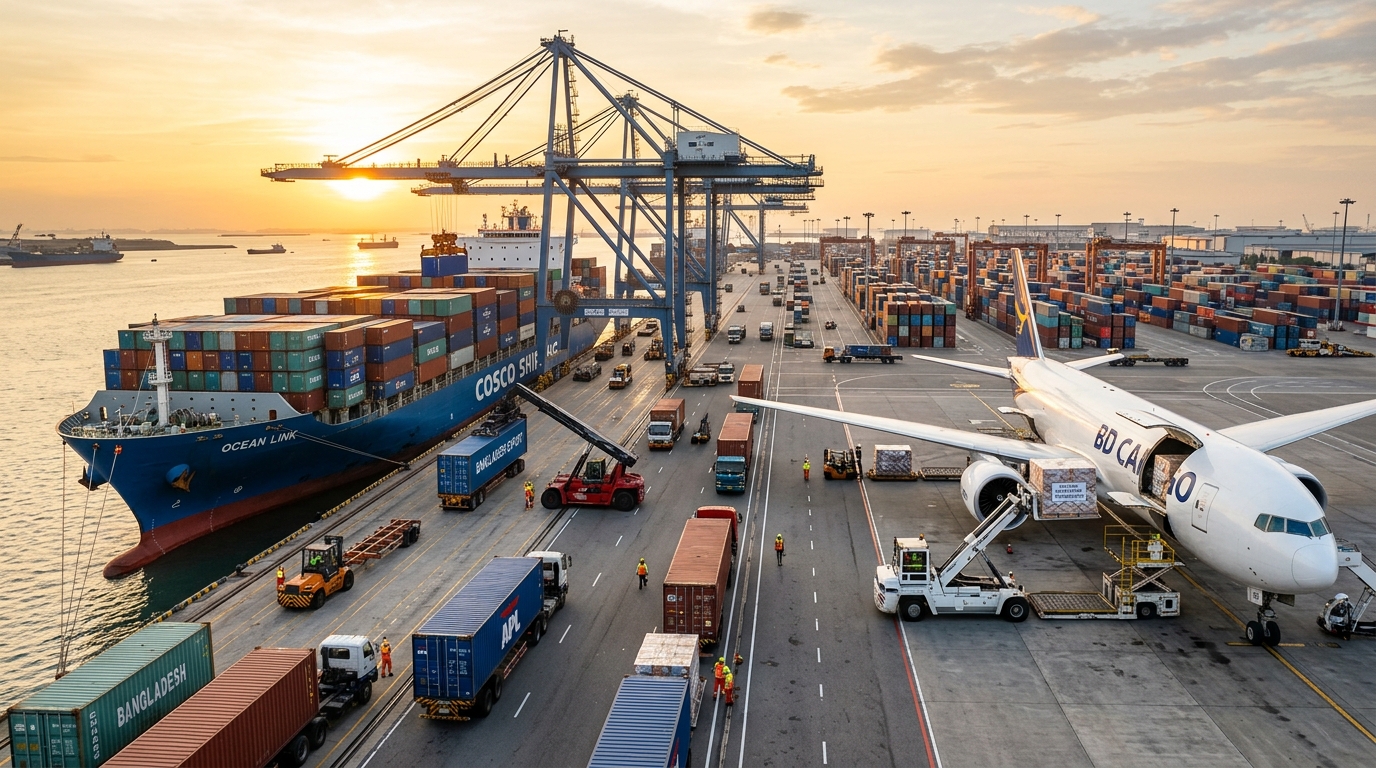
Maritime Ocean Freight (via Chittagong Port): High-volume merchandise, wardrobe organizers, household utilities, and heavy lifestyle accessories are shipped via maritime container vessels departing from ports like Ningbo-Zhoushan, Shenzhen (Yantian/Shekou), or Guangzhou (Nansha). Consignments can be booked as Full Container Load (FCL - 20ft or 40ft containers) or Less than Container Load (LCL consolidated groupage). Ocean freight takes 14 to 21 transit days to arrive at Chittagong Port. It offers the lowest cost per unit, calculated on a Cubic Meter (CBM) volume basis.
Express Air Cargo (via Dhaka HSIA Airport): For high-demand smart gadgets, newly launched electronic devices, and time-sensitive replacement inventory, Air Cargo is essential. Flying from Guangzhou Baiyun (CAN) or Shenzhen Bao'an (SZX) to Hazrat Shahjalal International Airport (DAC) in Dhaka takes just 3 to 5 business days. Air freight is priced per kilogram (using actual gross weight or volumetric weight, whichever is higher).
| Logistics Attribute | Ocean Freight (Sea / LCL / FCL) | Express Air Cargo (Air) | Door-to-Door (D2D) Express |
|---|---|---|---|
| Primary Entry Port | Chittagong Sea Port (CTG) | Hazrat Shahjalal Airport (DAC) | Chittagong / Dhaka Warehouses |
| Average Transit Time | 14 to 22 Days | 3 to 5 Days | 5 to 10 Days |
| Pricing Metric | Per Cubic Meter (CBM) | Per Kilogram (Gross or Volumetric) | All-inclusive per Kg or CBM |
| Minimum Chargeable Volume | 1 CBM (LCL) or Container (FCL) | 45 Kg minimum standard | 10 Kg to 20 Kg minimum |
| Customs Duty Handling | Commercial Bill of Entry clearance | Air Cargo Village formal assessment | Consolidated agency clearance |
| Ideal Product Types | Organizers, furniture, heavy accessories | Smart gadgets, earbuds, micro-electronics | Seasonal consumer lifestyle goods |
4. Bangladesh Customs Clearance: HS Codes, NBR Tariff Assessment & Documentation
Entering goods into Bangladesh requires strict compliance with the National Board of Revenue (NBR) and the Customs Act. Importers who attempt to cut corners or declare improper classifications face severe penalties, container seizure, or punitive demurrage fines.
Every commercial import consignment requires complete and verified documentation:
1. Bill of Lading (B/L) or Air Waybill (AWB): The legal contract of carriage and document of title issued by the shipping line or airline.
2. Commercial Invoice: Itemized list detailing product descriptions, unit costs in USD or RMB, total FOB/C&F value, and country of origin.
3. Packing List: Precise breakdown of box numbers, gross weight, net weight, individual carton dimensions, and total CBM.
4. Certificate of Origin (Country of Origin / Form CO): Issued by the China Council for the Promotion of International Trade (CCPIT) confirming manufacturing origin.
5. Harmonized System (HS) Code Classification: The 8-digit international commodity classification code recognized by Bangladesh Customs. Determining the correct HS Code dictates the total duty burden, which consists of Customs Duty (CD), Regulatory Duty (RD), Supplementary Duty (SD), Value Added Tax (VAT 15%), Advance Income Tax (AIT), and Advance Tax (AT).
- Always match product descriptions on the commercial invoice exactly with physical carton markings.
- Ensure the declared HS code complies with the latest Bangladesh National Board of Revenue (NBR) Tariff Schedule.
- Ensure Letter of Credit (LC) or Sales Contract payment terms comply with Bangladesh Bank foreign exchange regulations.
5. Chittagong Sea Port & Off-Dock ICD Operations: Avoiding Costly Demurrage
Chittagong Port handles over 90% of Bangladesh's international maritime trade. Once container ships berth at the Chittagong Port Authority (CPA) jetties, containers are discharged and transferred to one of the 19 private off-dock Inland Container Depots (ICDs) surrounding Chittagong (such as Incontrade, Esack, Vertex, or QNS).
At the off-dock ICD, the container is destuffed or presented for physical customs examination by the assigned Customs Appraiser. If paperwork contains discrepancies, or if the importer delays submitting the Bill of Entry (B/E), shipping lines and port authorities impose daily Demurrage and Detention charges that quickly escalate into hundreds of thousands of Taka.
At Uzvi Enterprise, our logistics team utilizes pre-arrival electronic customs manifest filing. We ensure all customs declarations are processed concurrently with vessel arrival, clearing cargo from the ICD in the shortest possible timeframe.
Demurrage Prevention Standard
“Pre-clearing documentation before vessel berthing saves up to 5 to 7 days in off-dock dwell time, completely eliminating container demurrage fees and safeguarding profit margins.”
6. Door-to-Door (D2D) vs. Enterprise Port-to-Port Consignments
Small to medium businesses in Bangladesh frequently choose Door-to-Door (D2D) cargo services. In a D2D arrangement, a specialized forwarding agency consolidates shipments from multiple merchants into a single master container or air consignment, handling export customs in China, international freight, Bangladesh customs clearance, and domestic delivery for an all-inclusive rate per kilogram or CBM.
While D2D is convenient for lower volumes, growing businesses like Uzvi Enterprise transition toward direct corporate import lines. Corporate port-to-port imports provide complete legal ownership, verified tax invoices, direct warranty support from original equipment manufacturers, and full legal compliance with local consumer protection agencies.
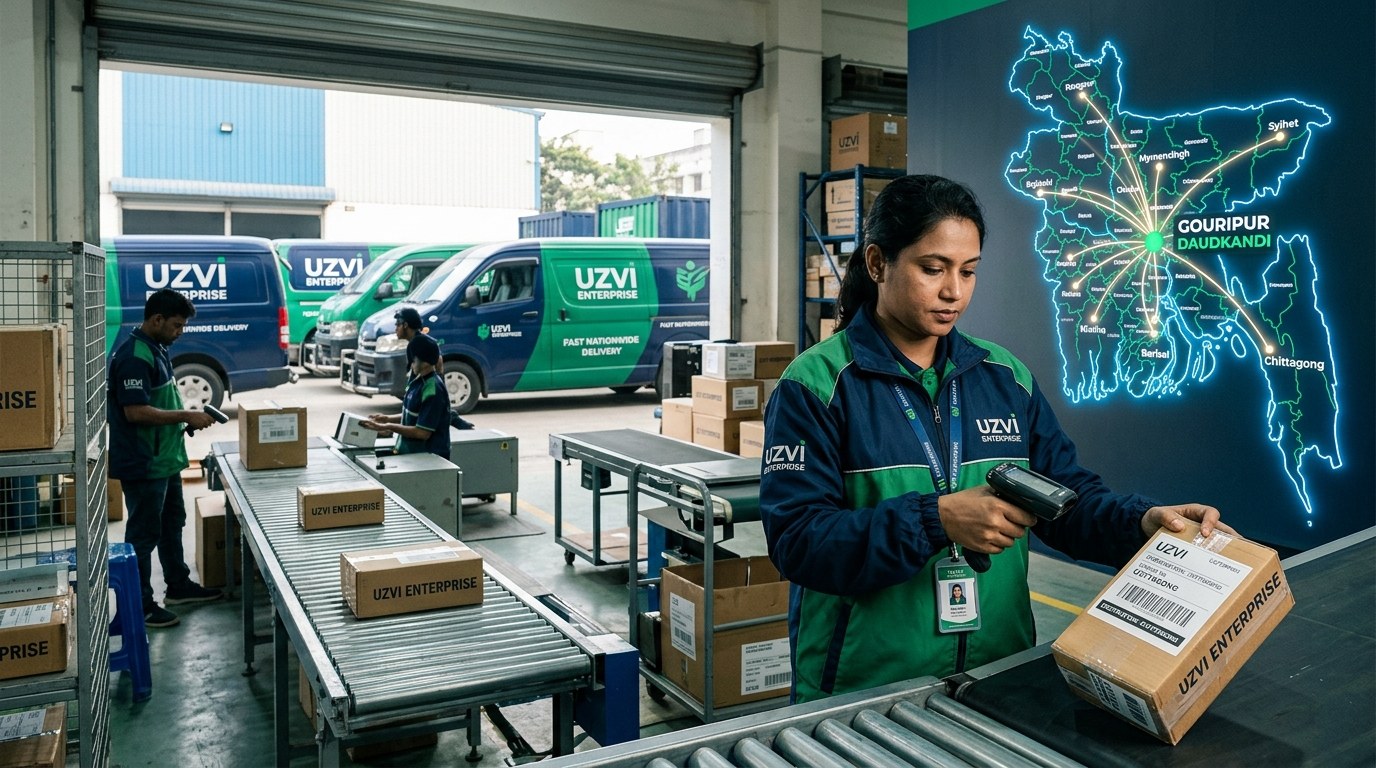
Once our shipments clear customs at Chittagong Port or Dhaka Airport, they are loaded onto dedicated logistics transport vehicles and routed directly to our centralized fulfillment hub in Gouripur, Daudkandi (Postal Code 3517), Chittagong. Situated right along the national expressway, this allows instant inventory intake, barcoding, and dispatch to customers across all 64 districts in Bangladesh.
Mastering the China to Bangladesh trade corridor bridges global manufacturing power with local household demand. By enforcing rigorous factory audits, selecting optimal freight routes, clearing customs legally, and operating from our strategic Gouripur highway hub, Uzvi Enterprise delivers genuine, warranty-backed products at unbeatable prices across all 64 districts.
Frequently Asked Questions (FAQ)
Common queries verified by Uzvi Enterprise trade & customer specialists.